Most things you ‘know’ about science and religion are myths or half-truths that grew up in the last years of the nineteenth century and remain widespread today.
The true history of science and religion is a human one. It’s about the role of religion in inspiring, and strangling, science before the scientific revolution. It’s about the sincere but eccentric faith and the quiet, creeping doubts of the most brilliant scientists in history – Galileo, Newton, Faraday, Darwin, Maxwell, Einstein. Above all it’s about the question of what it means to be human and who gets to say – a question that is more urgent in the twenty-first century than ever before.
From eighth-century Baghdad to the frontiers of AI today, via medieval Europe, nineteenth-century India and Soviet Russia, Magisteria sheds new light on this complex historical landscape. Rejecting the thesis that science and religion are inevitably at war, Nicholas Spencer illuminates a compelling and troubled relationship that has definitively shaped human history.
I can’t get to Cambridge for the talk but the book is definitely on pre-order.
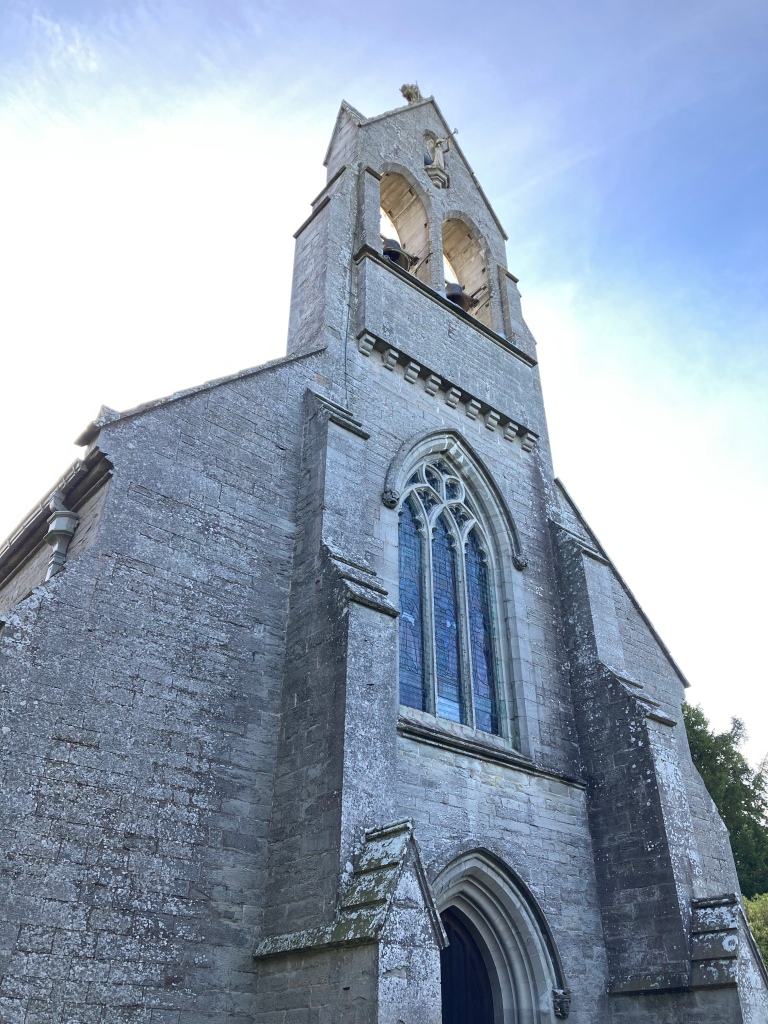
St Mary’s Tretire is another tiny gem in the Garway Hill area between Hereford and Ross, a nove 19th century rebuild of a medaeval predecessors. The far from populous parish even boasts a second church at Michaelchurch, even more remote – which was a good thing as when I took the Candlemas service there recently on a superb early spring day with an equally super congregation, the safe lock failed and the churchwarden had to shoot off at high speed to fetch the silver from the other church. I was naughtily reminded of the comment of a Dean of Ely, when the Dioceses Commission were contemplating merging that diocese with Peterborough, that a second cathedral would be very useful for spares …
St Dubricius brought the Gospel to these parts even before the Saxons, and some earlier Roman folk of the faith may have preceded even him. The light still shines.
Back in November we visited the newly open and rather wonderfully restored castle at Hay on Wye, and after coffee and Welsh cakes (of course) had to pop into the gallery to pay our respects to The King. A purchase did of course also have to be made at his bookshop. We are told that some still think the Decision Maker does a better job than those in charge of several countries today …
One of the perks of being an FSA (Fellow of the Society of Antiquaries of London – alongside a fine library at Burlington House that will actually post books out to us in the sticks!) is free entry to Kelmscott Manor, which the SAL look after (https://www.sal.org.uk/kelmscott-manor/). That was of course home to William Morris, and it was his influence, perpetuated by the Society for the Protection of Ancient Buildings, universally known as SPAB (https://svbb.org.uk/kelmscott/) that has meant that the 12th/13th century church of St George in the village is wonderfully preserved: a good solution for such a church in a village of 100 souls, where this side of Revival and even beyond there is never going to be much of a congregation or demand for all-singing all-dancing parish church activity.
Star of the show for me were the wall paintings of c.1280 and the one showing Cain’s murder of Abel (above) is the most dramatic. Cain’s hairstyle says it all.
The manor, church and village make a splendid destination if you’re in the Cotswolds and Oxford area: do call in.
Regular readers may remember that Jean and I went to look at the rather special church at Garway not long ago, founded by the Templars (originally with a circular nave) then taken over by the Hospitallers, before they too were dissolved, after which it continued to serve such local community as there was – and still does.
Since then I’ve been to take a service there too, and also been recruited to talk to the local Heritage Group (https://www.garwayheritagegroup.co.uk/historic-garway/early-middle-ages) later in the year. As they know their local history far better than any outsider like me, that’s quite a call. I can probably chip in with a little more about the Hospitallers because of my St John connections, but one of their number has actually written a small book on their acitivity in Herefordshire…
So I’m mining what I know about education in those times, and the manuscripts surviving from Pencoyd just down the road will be a great help. In one of those there is a list of folk owing money to the curate, and interestingly many of the names are in the Welsh style. That’s not so surprising when you remember that these villages are in the old British/Welsh territory of Erging/Archenfield, but the very late fifteenth century (which is when the MSS date from) is a sharp reminder that Welsh was still being spoken there as late as that.
We know it was the local lingo a century before in 1397 because in the Hereford Cathedral Archives the manuscript notes survive (as HCA 1779) from the Bishop’s Visitation of that date, recently published with a translation by Ian Forrest and Christopher Whittick (https://boydellandbrewer.com/9780907239840/the-visitation-of-hereford-diocese-in-1397/). You can look that up as a crib, but I’ve given you the real thing above, and as well as the usual shenanigans, the passage boxed in red tells us that “Item, the same Sir [ie the parochial chaplain Richard, not a knight] is not able to manage the cure of souls there because he doesn’t know the Welsh language and most of the parishioners don’t know the English language” – and indeed several of the parishioners cited from parishes in that area have Welsh names.
My photo taken with kind permission at Hereford Cathedral Library: not for further reproduction.
DALL·E 2 is a new AI system that can create realistic images and art from a description in natural language (https://openai.com/dall-e-2/). I typed in something like “Paint a picture of a choir singing carols in church on Christmas Eve in the style of David Hockney” and got this. Obviously it’s highly derivative from other artwork and information it has acquired in general from the web, but it’s still a big step beyond the application of a filter or algorithm
Then look at gpt-3, the engine that’s driving the AI chatbot revolution (https://chat.openai.com/chat). Type in something in plain langauge, like “Create a sermon for the feast of the circumcision of Christ” and you might get this (it’s different every time because it’s created on the fly):
Dear friends, Today we celebrate the feast of the circumcision of Christ, also known as the Feast of the Holy Name of Jesus. This is a day when we reflect on the great mystery of the Incarnation, and the tremendous love that God has for each and every one of us. On this feast day, we remember that Jesus, the Son of God, was born into this world as a human being, subject to the same trials and challenges that we all face. He was circumcised according to Jewish law, just as every male child was at the time.
But this simple act of obedience took on a much deeper meaning when it was performed on Jesus. For through his circumcision, Jesus was fully and truly made one of us, taking on our humanity in all its fullness. He became fully human, fully God, and through his death and resurrection, he reconciled us to the Father and opened the way for us to share in his life and love.
As we celebrate the circumcision of Christ, let us remember the great love that God has for us. Let us give thanks for the gift of the Incarnation and for the gift of Jesus, who willingly took on our humanity and suffered and died for us. Let us also remember that through our own baptism, we are called to follow in Jesus’ footsteps and to share in his mission of love and reconciliation. May the feast of the circumcision of Christ fill our hearts with joy and gratitude, and may it inspire us to live our lives in a way that reflects the love and self-sacrifice of Jesus. Amen.
Now that’s clever. But also, typically of the AI, it is not correct. The incarnation not the circumcision establishes Christ’s identity with us (or goodbye half of humanity – which means it also dangerous in the wrong hands). The programs are very explicit that they way they create means that they are plausible not accurate. That is SO typical of the world we are starting to inhabit.
So I decided to have a pop at it in a magazine article for St Weonard’s this February(https://www.stw.org.uk) and stick up for real humanity. We had a rather good attendance by the way!
Hello fellow churchgoers!
I hope this magazine finds you well and that you had a wonderful Christmas season. Can you believe it’s already February and Candlemas is upon us? Time sure does fly, doesn’t it?
It’s all right: don’t have a heart attack! That wasn’t really me speaking but an Artificial Intelligence program following my instructions to write a chatty magazine article for Candlemas… It’s scary how much these programs can do now. An average student essay is within their grasp for instance. But the truth is, they often don’t pass the “sniff test”. They just aren’t really human, however clever they are at feeding the internet back to us.
Which takes me back to Candlemas, because Candlemas – the Feasts of the Presentation of Jesus Christ in the Temple and the Purification of the Blessed Virgin Mary – is our yearly celebration of a very real baby and a very real mother going to a very real Temple to perform the rituals their religion required: presenting sacrifices to God and praying for purification for Mary (as recorded in Luke chapter 2), 33 days after the equally physical circumcision and 40 days after the birth.
This is no escapist world of twinkling candles and chatty platitudes, but the real world full of joys and sorrows that we know today. And it celebrates, as you well know, not a mythical God but a God who has become fully one with us, blood and gore included. God with us in both our joys and sorrows. God with us a New Year unfolds.
Ritual sacrifices and cleansings are no longer part of our religion. Nor do we bring our stock of candles to church for blessing (made from the tallow of the slaughtered pigs …). What the Feast does offer is the opportunity to take a deep breath of God’s Spirit and turn bravely from the cosiness of Christmas to face the more challenging days of Good Friday and Easter and all they represent, taking with us not a just a candle in our hands but the light of Christ in our hearts. That’s what we’ll be doing at Tretire on Sunday 5th February at 10am if you’re free to join us.
Coming south from a visit to Durham in early autumn we revisited the Locomotion museum at Shilsdon https://www.locomotion.org.uk/home. I’m collecting information and models for a railway layout based on the very early years of railways with scenes representing the pre-loco wagonways at Throckley which one of Jean’s ancestors built, the cottage down the road where George Stephenson lived (with an imagined workshop attached), with tracks running into Newcastle where we time travel to the opening of the High Level Bridge by Queen Victoria, and on to North Shields where another of Jean’s ancestors is waving her husband off on a collier ship en route to London. A few locos and wagons from this period are now starting to be available ready-to-run but surprisingly Locomotion itself is not one of them. Someone at the museum did say though that some folk perhaps from a modelling company had been taking measurements… Meanwhile a 3D printed kit to help a really hardy modelmaker have a go themselves is on the market, but may be beyond my skills (especialy if an RTTR is just round the corner). I had great fun working out what all the bits of mechanism on the real thing were actually doing: not actually that complicated but still quite a puzzle. Fascinating.
I’m way behind on posts for this blog so am trying to catch up…. Way back in the summer we stopped off at Mount Grace Priory (https://www.english-heritage.org.uk/visit/places/mount-grace-priory/) which, very suprisingly, we had not been to before. It is a National Trust property but “operated” by English Heritage: a bit odd, but I’m sure there’s a sensible reason for that. Either way, it now boasts a welcoming, cosy and appropriately constructed café and shop at the entrance, alongside well-conserved buildings, one of which has been reconstructed as the small house each (Carthusian) monk occupied, complete with scriptorium room and rather slendid small garden.
Carthusians spent most of their time in these cells, with most meals delivered to them through a sort of hatch by lay brothers, coming together only for principal services and meetings. At least one bishop “retired” to become a lay brother, so the servants were pretty classy! All in all, if I was on my own its the sort of life that I could well have felt called to … Brother Bruno, who came home with us to provide spiritual care for our collection of small bears, must have agreed, and I wonder if we will be able to keep from sneaking off back home.
Just back from presiding at the Holy Communion at Hardwicke (BCP, helping cover a sabbatical). It’s a little jewel-box of a church, built by the local Big Family whose ordained son (I was told) couldn’t find a suitable living so they built a church for him and persuaded the Bish to divide the parish. It’s also in relatively deep countryside so unsurprisingly the congregation like the church is small in number (12 communicants; but that’s what Jesus chose…) if big in commitment. The organ pipes are so finely decorated that they are listed. Blessings on the faithful few who keep the daily round and common task going and still say their prayers.
At St Weonard’s Church, Herefordshire, Sunday 18th October
Then I saw a new heaven and a new earth; for the first heaven and the first earth had passed away, and the sea was no more.
In the name of the Father and of the Son and of the Holy Spirit. Amen.
I find the words we have just heard from Revelation incredibly moving. They come from the very end of the Bible, a sneak peek for us if you like of the end of the story, and tell us that however hard and grim life can be, all shall be well. Heaven and earth, all that is, will be made new, and every tear will be wiped away, and death will be no more.
That of course is our prayer for our late Queen and her family, and all who mourn at this present time.
When I was here last week for a wonderful service combining the baptism of young George Thornley with prayers for the Queen, I shared the moving little picture that’s doing the rounds on the internet of three figures walking away from us, Her Majesty, Paddington Bear, and a Corgi. “Where are we going, ma’am? asks Paddington. “Home, Paddington,” replies the Queen, “We’re going home.” It brought a tear to my eye as I thought how much the Queen deserved to be at home and at rest after a life so lived in public and so full of duties.
Our faith gives real and deep meaning to that word “home”: not just wishful thinking but the enfolding love of the living God in whom the Queen had so clearly put her trust, and I thank God with all my heart for that hope and that truth. Without it I personally would really struggle with my mental health; with it I can find enough hope and enough strength to play my part and see the journey through.
Our faith and indeed the words from the Bible that I’ve taken as the basis for this sermon offer us, though, even more than that,
Just as the Queen’s life of service was not only admirable in her individually as a person, but a powerful way of building up our nation and its communities together, so God promises us not just the making new of heaven, but the making new of the earth. Christianity from the beginning, and Judaism before it, has not been a religion as some are that simply offered an escape route from the earthly realities. It has been committed to sharing with God in the work of building his kingdom of peace, justice, and love “here on earth as it is in heaven”, as we pray every day in the Lord’s Prayer.
Our first reading spelled out for us the scale of that challenge:
The spirit of the Lord God is upon me, because the Lord has anointed me; he has sent me to bring good news to the oppressed, to bind up the broken-hearted, to proclaim liberty to the captives, and release to the prisoners; to proclaim the year of the Lord’s favour, and the day of vengeance of our God; to comfort all who mourn; to provide for those who mourn in Zion–to give them a garland instead of ashes, the oil of gladness instead of mourning, the mantle of praise instead of a faint spirit.
That was the challenge Queen Elizabeth accepted when she was anointed as our Sovereign, and which she lived out so faithfully through all her days.
Is that a call and a challenge just for monarchs then? The answer of course is no. When I baptised George, I anointed him too, with the sign of the Cross; and when I confirm and ordain people they are anointed again. All God’s people are called to be active citizens of his coming kingdom, not just trying their best to keep its commandments, but seeking to be like salt, yeast and light as Jesus put it, raising agents if you like bringing the new resurrection life of Christ into the sticky doughiness of everyday living and giving it a beautiful aroma and taste just as in fresh-baked bread.
There are some things we don’t fully know and understand here. St John in the Book of Revelation is using poetic language and it can be hard to be sure just what a new or renewed heaven and earth will look like and mean, or just how in the end evil and corruption and death will be wiped away. But that’s not a surprise really. We are very clever, and our science is very powerful, but we just don’t have the tools to look beyond the ordinary material world and answer the question of what lies there.
We need to make an act of faith. Either to believe that there is nothing there – and that all this talk of meaning and purpose and good and evil is just invented by us and will die with us. Or to believe as I do that from the beginning God’s Spirit has been at work in the world, breathing more into it than what we call matter, loving it, teaching it to love too, calling us to be beings which share his life of love, and calling us beyond this life that we know to share in love with him for ever. And in the meantime, to not just pray “your kingdom come” but join in making it happen.
At the moment we are like the characters in the Lord of the Rings, part way through a perilous journey, faced with evil that seems beyond us to defeat, and unsure that our quest will ever be complete; but we can, if we choose, be gripped by the faith that the good is real and will in the end prevail, and be the people who find the strength and the courage to see our quest through to the end.
Today we remember and give thanks for one such life, for one such person, a person who placed her faith in God, who received the anointing of God, and lived her life his way, for him and for her people. We pray that Charles too will live such a life, but since this is not something just for monarchs, for the great and good who have gathered for the funeral and hold the reins of power, we pray too for ourselves.
There is a radical democracy and inclusion built into God’s plan and God’s coming kingdom.
Everyone matters; you matter.
Everyone is called into active service; you are called into active service.
Everyone is to be anointed with the Spirit, you are to be anointed with the Spirit.
Everyone can and must play their part, you can and must play your part, in seeing the new heaven and new earth come.
We may not know how it will come, or when it will come. But in the faith of God and in the name of all that us good, surely it will come. And life will be proved to have been not in vain; not just ashes in the wind but a song in the air, building the harmony of heaven, and a world of beauty and peace.
Once when change was sorely needed in South Africa, the police entered a church where Desmond Tutu was preaching. The congregation held their breath as, risking arrest, he did not tone down his sermon but faced the police directly.
“You are powerful,” he said. “You are very powerful, but you are not gods and I serve a God who cannot be mocked. So, since you’ve already lost, since you’ve already lost, I invite you today to come and join the winning side!”
With that the congregation erupted in dance and song. The police didn’t know what to do. Their attempts at intimidation had failed, overcome by the archbishop’s confidence that God and goodness would triumph over evil. It was but a matter of time.
A matter of time. And now perhaps is the time, as we remember the life so well lived of our late Sovereign Elizabeth, to follow her example and join the winning side too, getting ready for the time that will surely come, when the earth will be filled with the glory of God, as the waters cover the sea.




 A Bishop's Blog